
What is “The Integrated Self” ?
The Integrated Self points to a relational cohesion between all that exists within and around you. As Walt Whitman put so succinctly, we "contain multitudes." As you get to know the multitudes, deepening your relationship with yourself and the wider world, you can perceive and create greater harmony with the multifaceted co-becoming that is you and all of life. Sometimes requiring boundaries, sometimes requiring openness, the mission of The Integrated Self is to help us live and act in integrity and authenticity with the wholeness of who we each are.
This essay explores the orientation and philosophy of The Integrated Self through the symbolism of the logo.
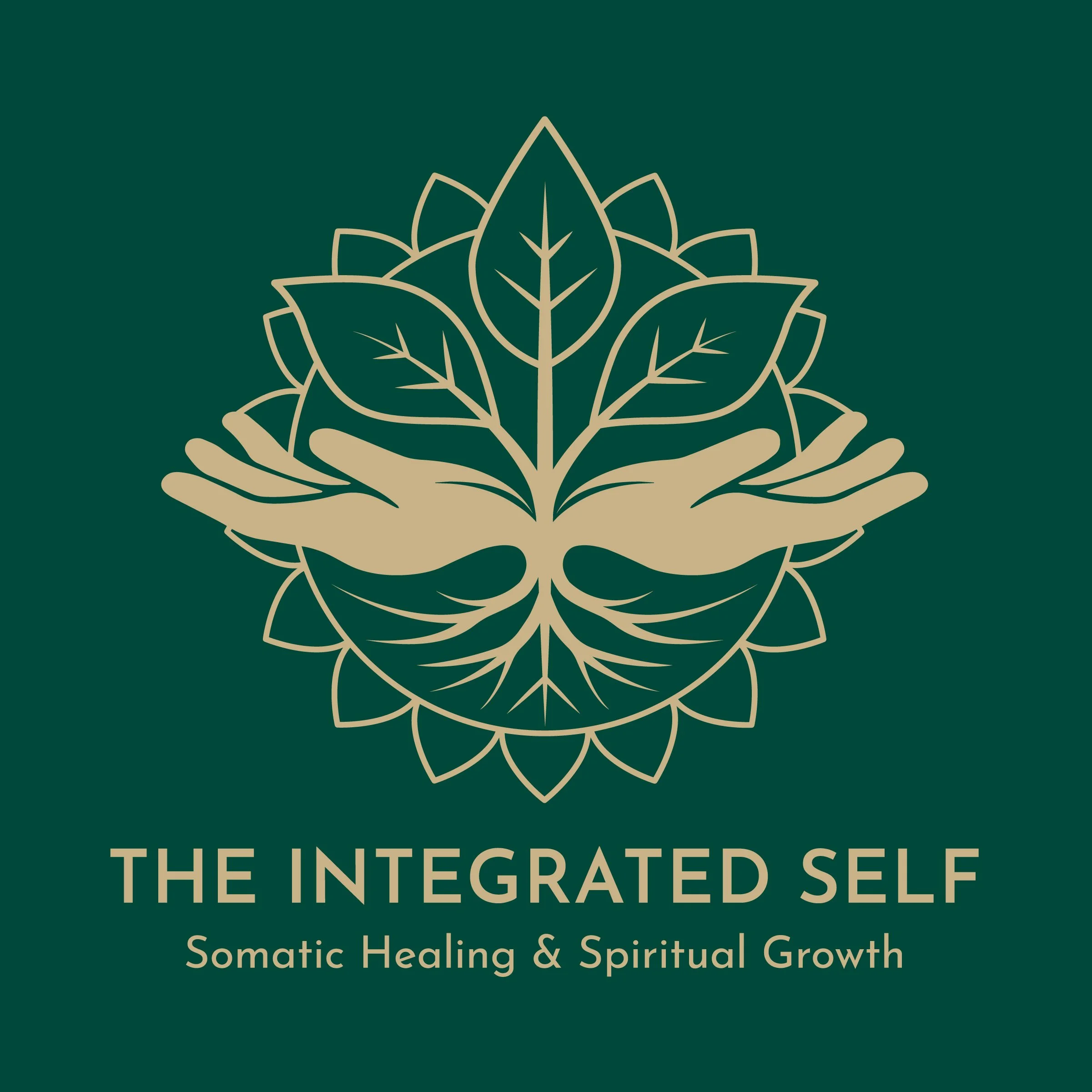
The logo has 5 main elements: human hands, plant leaves, roots, a circular mandala, and empty space.
The Human
The outstretched hands represent the individual human in an open and receptive posture—open to change, growth, and to relating with the world. Also open to taking personal accountability and responsibility for one’s choices and reactions.
One way of orienting to the human is through a three-centered model used by some Sufis, contemplative Christians, and other mystery schools: (1) The head center thinks and reasons, (2) the heart center feels emotions, and (3) the belly or body center senses, experiences, moves, and expresses. An “integrated self” can experience a clear and fluid channel of alignment between all three centers in the body, accessing a wider and deeper range of faculties, capacities, and potential as needed—thinking, feeling, sensing, moving, imagining, intuiting, empathizing, understanding, dreaming, creating, emoting, expressing, attuning, and utilizing more of oneself in appropriate ways for any situation.
The integrated human also includes many different parts: the inner child, the inner teenager, paradoxical desires (the part that wants to stay where you are and the part that wants to move), the black and white thinking parts, the more open and nuanced parts that can hold a both/and perspective rather than an either/or perspective, the wisest, most compassionate, peaceful parts, and the most contracted, reactive, and pained parts. The integrated self is an individual who can choose which parts get to lead oneself in any situation, and which parts need validation, compassionate holding, and/or inner boundaries.
This integrated, individual human is one key aspect of the integrated self. Then there’s the transpersonal element, beyond the singular, individual self.
The More-Than-Human
The plant leaves in the logo first represent the more-than-human world. We depend on plant-life and the more-than-human, and are embedded in existence with countless forces and beings, including a wider network of elements, animals, microorganisms, corporations, institutions, spirits of place, ancestors, and so much more. Seen here, the leaves are co-emerging out of the same center as the human hands, recognizing that at our core we are intimately connected with all of life.
The growing leaves also represent the possibilities of growth for every person: that we can awaken our authentic truth and expression in everyday life, blooming as vibrantly as the plant kin do.
The Roots
For this growth to take place, we must first and foremost be rooted in our lives. All beings, including humans, are literally rooted into a web of life much greater, and more powerful, than any individual. We arrive into history, into culture, into intergenerational traumas and resilience, burdens and gifts; and that context and circumstance informs and influences much of who we are. It’s therefore essential to acknowledge our positionality, the context in which we find ourselves, to most effectively respond to the current moment. When we know what kind of soil we are growing in, we can identify and choose what kinds of nutrients we may need to strengthen our growth, and what kinds of influences may be harmful or even toxic to our flourishing.
The Transcendent and The Immanent
While being rooted in the substantial weight of physical circumstances, if we dig even deeper into the nature of reality, we find our roots extend out to and grow from vast empty space—the pre-conceptual, primordial, groundless ground of being from which all things emerge and return. Not much can be said to accurately convey this dimension, as words are things, and the empty space is no-thing. This is why esoteric teachings are esoteric—they point to realities that are not intellectually understandable concepts, but unique felt experiences. Nonetheless, the empty space is always here, and is experienceable through different practices, such as certain types of meditation and entering into different states of awareness.
Surrounding the empty space and everything within it is the mandala, which signifies the nondual unity of existence. The mandala represents a kind of perfection, a symmetrical ideal, often associated in mystical and wisdom schools with the divine masculine principle of transcendence. The roots, the hands, and the leaves represent the unique specificity and details of life—your unique fingerprint, the way the wind blows your hair, the bacteria in your body, the events of your life—often associated with the divine feminine principle of immanence.
One of my favorite parts of this logo is how the hands and the leaves break through the mandala, transgressing its seemingly final and perfect symmetry, because life is messy, we make mistakes, and it’s not always so clean cut. The funny, heartbreaking, and mind-stopping thing is that the messiness of every detail of life does not nullify the beauty and perfection of the mandala. This is the interdependent nature of life—how the specifics can break through the mandala, transgress the unity, and still remain ingrained within it. The dual and the nondual, overlapping, working, and living together.
Integration
The integrated self allows for paradox—the both/and reality of being an individual and part of the unity of all that is—and knows that we cannot actually harm the wholeness of it all. No inner part, no outer person, does not belong. Of course, some parts and people can create harm for others, and sometimes the most compassionate action is one of holding boundaries and working towards change, and that work is also part of the wholeness of the all and everything.
There are no wrong notes in the symphony of existence, and, we can learn, practice, and cultivate the attunement and discipline necessary to play the notes that better express the grandest, most beautiful, and loving story possible.
Taken as a whole, the integrated self is an individual who is humbly and powerfully dancing with the fullness of all that is, within and without, the dual and the nondual, the transcendent and the immanent, self and other. Discerning each next right action as best it can, this self acknowledges and even revels in the interdependent nature of life, respectful of all else and honoring their own role in the play. The integrated self consciously participates in the evolutionary movement of growth and balance, from the earthly to the cosmic, embracing their authentic truths, their grandest visions, their missteps, their gifts, and the unfolding process of living in all of its excruciating beauty.
If you’d like focused, one-on-one guidance on how you can live more in an integrated way, email me at dan@integratedselfcounseling.org, or schedule a free 20-minute consultation with me, to see how I can support you stepping into your integrated life.
